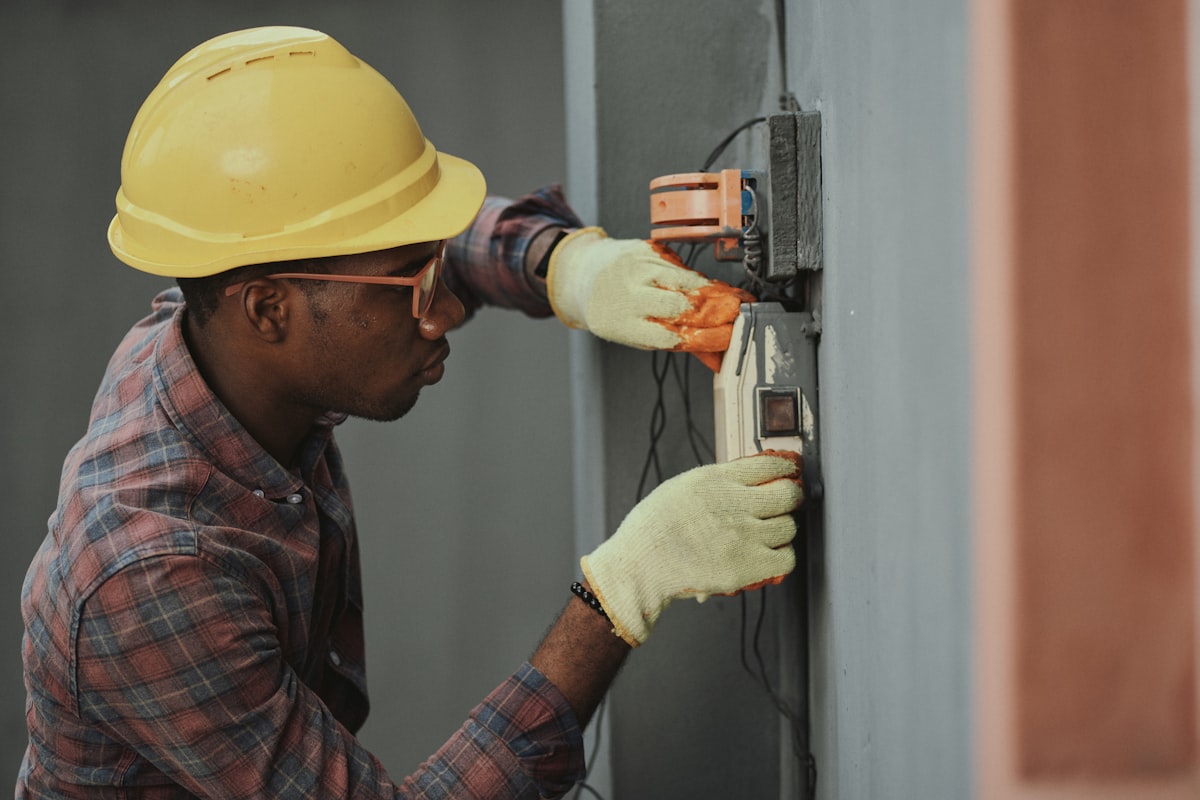
A safety switch that trips every morning. Downlights that flicker when you turn on the oven. A switchboard from the 1970s with ceramic fuses and no safety switches. When electrical problems start showing up in your Victorian home, you need a licensed electrician, not someone’s cousin who did a sparkie course ten years ago.
Victoria has its own electrical safety regulator, Energy Safe Victoria (ESV), which licences and registers every person and business authorised to perform electrical work in the state. With over 23,000 licensed electricians across Australia listed on TradieVerify, finding a qualified sparkie in Melbourne, Geelong, or regional Victoria should be straightforward. But Victoria’s licensing system has its own rules, and the penalties for getting it wrong went up significantly in 2025. This guide covers how to hire a licensed electrician in Victoria, from verifying ESV credentials to understanding Certificates of Electrical Safety and knowing your rights when something goes wrong.
Why You Must Hire a Licensed Electrician in Victoria
In Victoria, all electrical installation work must be carried out by a person who holds a current electrical licence issued by Energy Safe Victoria under the Electricity Safety Act 1998. There is no minimum job value and no exceptions for small jobs. Replacing a power point, installing a light fitting, or adding a circuit to your switchboard all require a licensed electrician in Victoria.
It is the law. The Electricity Safety Act 1998 makes it an offence to perform electrical work without the appropriate licence. From May 2025, the Energy and Land Legislation Amendment (Energy Safety) Act 2025 increased maximum penalties significantly. Installing unsafe electrical equipment now carries penalties of up to 240 penalty units for individuals (approximately $47,400) and 1,200 penalty units for companies (approximately $237,000).
ESV can act fast. Under the 2025 amendments, Energy Safe Victoria gained the power to immediately suspend an electrician’s licence or a contractor’s registration on public interest grounds. ESV can also apply for court injunctions and issue adverse publicity orders against convicted offenders. From April 2026, ESV officers can issue prohibition notices to halt activities creating immediate safety risks.
Your insurance depends on it. If unlicensed electrical work causes a fire or electrocution at your property, your home insurer can refuse the claim. Licensed electricians carry public liability insurance that covers you if something goes wrong during the job.
Certificates of Electrical Safety protect your home. After completing electrical work, a licensed electrician in Victoria must issue a Certificate of Electrical Safety (COES) confirming the work meets Australian Standard AS/NZS 3000 (the Wiring Rules). Failure to issue a COES is a criminal offence that can lead to suspension or cancellation of the electrician’s licence.
You can verify any electrician’s licence on TradieVerify’s search page or through the ESV public register.
How Victoria’s Electrical Licensing Works
Unlike building and plumbing trades, which are regulated by the Victorian Building Authority (VBA), electrical licensing in Victoria sits under Energy Safe Victoria (ESV). ESV is a standalone statutory authority responsible for electrical and gas safety across the state. You cannot check an electrician’s licence on the VBA website.
This is similar to Queensland, where the Electrical Safety Office (ESO) manages electrical licences separately from the QBCC. It differs from NSW, where the Building Commission manages both building and electrical licensing.
Victoria has a two-tier system for individuals doing electrical work:
Licensed electricians hold a full Electrician’s Licence (A Grade). They can perform electrical work independently and are authorised to test, connect, and commission electrical installations. This is what you want for any residential electrical work.
Supervised workers hold a Supervised Worker’s Licence (L) or Electrician (Supervised) Worker’s Licence (ES). They can only perform electrical work under the direct supervision of a licensed electrician. An apprentice on the job is fine, but they should not be working unsupervised at your property.
On the business side, Victoria requires:
Registered Electrical Contractors (RECs) are businesses registered with ESV to contract with customers for electrical work. A licensed electrician must work through a Registered Electrical Contractor to perform work for you. Even if a sparkie holds a personal licence, they cannot take on private jobs unless they or their employer is a registered REC.
When you hire an electrician in Victoria, check both: the individual doing the work holds a current electrician’s licence (A Grade), and the business they work for holds current REC registration.
Victoria’s Electrical Licence Types Explained
Before you hire an electrician in Victoria, understanding the licence types helps you confirm the person quoted for your job is qualified to do it.
| Licence Type | What It Covers |
|---|---|
| Electrician’s Licence (A Grade) | General electrical installation, maintenance, repair, testing and commissioning. This is the standard licence for residential work in Victoria, covering wiring, power points, switchboards, lighting, safety switches, and most domestic jobs. |
| Restricted Electrical Worker’s Licence (REL) | Limited electrical tasks connected to another trade. Held by plumbers, air conditioning technicians, and other tradies who need to disconnect and reconnect electrical equipment as part of their primary work. Cannot perform general electrical work. |
| Licensed Electrical Inspector (LEI) | Inspects and certifies electrical installations. Required for prescribed electrical work that must be independently inspected before it can be energised. |
| Supervised Worker’s Licence (L) | Apprentices and trainees performing electrical work under direct supervision. Cannot work independently. |
| Switchgear Worker’s Licence (SW) | High-voltage switchgear equipment work. Specialised infrastructure, not relevant for residential jobs. |
| Lineworker’s Licence | Powerline and network infrastructure work. Not relevant for home electrical work. |
For residential work, you want an electrician holding an A Grade licence. If someone mentions a restricted licence, supervised licence, or any other class, ask whether it covers the specific work you need done. For general home electrical work, only an A Grade licence will do.
How to Verify an Electrician’s Licence in Victoria
Checking a Victorian electrician’s credentials takes a few minutes. Do this before any work starts.
Step 1: Ask for their licence number. A legitimate licensed electrician in Victoria will provide this without hesitation. If they dodge the question or say they do not need one, do not hire them.
Step 2: Search the ESV public register. Go to the ESV public register at portal-public.energysafe.vic.gov.au. You will need to complete a CAPTCHA, then search by the electrician’s name or licence number. The register pulls live data from ESVConnect, so it reflects current licence status.
The register confirms:
- The electrician’s full name and licence number
- Licence type (A Grade, REL, Supervised, etc.)
- Whether the licence is current or expired
- Any conditions or restrictions on the licence
Step 3: Check the business REC registration. Search the same register for the Registered Electrical Contractor. Confirm the business is currently registered and the electrician you are hiring works under that REC.
Step 4: Ask for proof of insurance. Request a copy of their public liability insurance certificate. Most reputable electricians in Melbourne and regional Victoria carry $10 to $20 million in public liability cover.
You can also search for verified electricians on TradieVerify and check their credentials through the electrical licensing guide.
Certificates of Electrical Safety: What Every Victorian Homeowner Should Know
Victoria’s Certificate of Electrical Safety (COES) system is one of the strongest consumer protections for electrical work in Australia. Understanding it will help you hold your electrician accountable.
Under the Electricity Safety Act 1998 and the Electricity Safety (General) Regulations 2019, a licensed electrician and their REC must issue a COES for all electrical installation work performed at your property. There are two types:
Prescribed COES apply to major work that requires independent inspection by a Licensed Electrical Inspector (LEI) before it can be switched on. This includes:
- Consumer mains cables and main switchboards
- Meter boxes and earthing systems
- Solar photovoltaic (PV) system installations
- Battery energy storage systems
For prescribed work, the electrician must provide you with a copy of the COES within 4 days of the inspection being completed. The installation cannot be energised until the LEI has inspected and signed off on it.
Non-prescribed COES cover routine work such as installing lights, power points, air conditioning circuits, and other standard residential electrical work. Your electrician must provide you with a copy of the non-prescribed COES within 30 days of completing the work.
If your electrician does not provide a COES, report them to ESV. Failure to issue a COES is a criminal offence that can result in infringements, licence suspension, or licence cancellation. Do not let an electrician talk you out of getting one.
Keep every COES you receive. They form a compliance record for your property that matters when you sell your home, make insurance claims, or if a fault develops later.
How Much Does an Electrician Cost in Melbourne and Victoria?
Knowing typical rates helps you spot quotes that are suspiciously cheap (unlicensed risk) or unreasonably high. Here is what licensed electricians in Victoria typically charge.
| Service | Typical Cost (incl. GST) |
|---|---|
| Hourly rate (standard hours) | $85 - $140/hr |
| Call-out / service fee | $70 - $140 |
| After-hours / emergency rate | $150 - $200/hr |
| Safety switch installation | $180 - $350 |
| Switchboard upgrade | $1,200 - $3,500 |
| Power point installation | $150 - $250 per point |
| Ceiling fan installation | $200 - $400 |
| LED downlight installation | $80 - $120 per light |
| Smoke alarm installation (hardwired) | $150 - $250 per alarm |
| Full home rewire (3-bed) | $8,000 - $20,000 |
Most Melbourne electricians charge in 15-minute increments after the initial call-out fee. Inner-city and bayside suburbs tend to sit at the higher end. Regional Victoria rates are often 10 to 20 per cent lower than Melbourne.
Get three quotes. This is standard practice in Australia. Make sure each quote includes the call-out fee, hourly rate, materials, and whether GST is included. A written quote protects both you and the electrician.
What You Can and Cannot Do Yourself in Victoria
Victoria has some of the strictest rules in Australia about DIY electrical work. Here is a clear breakdown.
You CANNOT legally do any of these yourself:
- Replace a power point, light switch, or light fitting (even a like-for-like swap)
- Install or move any electrical wiring
- Work on your switchboard or safety switches
- Install ceiling fans, downlights, or exhaust fans
- Connect or wire up a hot water system, oven, or cooktop
- Install solar panels or battery systems
You CAN do these without a licence:
- Change a light globe (bayonet or screw-in type)
- Replace a fuse in your fuse box (if you still have rewirable fuses)
- Plug in appliances
- Reset a tripped safety switch or circuit breaker
The line is simple: if it involves wiring, connections, or anything inside a junction box or switchboard, you need a licensed electrician in Victoria. The Electricity Safety Act 1998 does not provide an owner-occupier exemption for electrical work, unlike some states that allow limited owner-builder electrical work.
Red Flags When Hiring an Electrician in Victoria
Watch for these warning signs before and during the job.
Before hiring:
- They will not provide a licence number or REC registration details
- They quote cash only and no invoice
- The quote is dramatically lower than other quotes (may indicate unlicensed or cutting corners)
- They cannot show proof of public liability insurance
- No business name, ABN, or fixed address
- They pressure you to decide immediately
During the job:
- No COES provided after work is completed
- They leave the installation energised before an LEI inspects prescribed work
- Wiring looks messy, with loose connections or exposed conductors
- They skip testing the installation before leaving
- An unsupervised apprentice is doing the work alone
If you spot any of these, contact Energy Safe Victoria on 1800 815 721 or email licensing@energysafe.vic.gov.au.
Your Rights Under Victorian Consumer Law
When you hire an electrician in Victoria, you have strong consumer protections.
Domestic Building Contracts Act 1995. For electrical work over $10,000 (which covers major jobs like full rewires or large-scale fit-outs), the DBCA applies. This means:
- The electrician must provide a written contract before starting work
- They cannot take a deposit of more than 5% of the contract price
- You have a 5 business day cooling-off period after signing the contract
- The contract includes implied warranties covering workmanship for 6 years (structural) and 2 years (non-structural)
For jobs under $10,000, the Australian Consumer Law still applies. All services must be provided with due care and skill, be fit for purpose, and be completed within a reasonable time.
DBDRV and VCAT. If a dispute arises, Victoria has a structured resolution process. You must first apply to Domestic Building Dispute Resolution Victoria (DBDRV), now part of the Building and Plumbing Commission, for free conciliation. If conciliation fails, you can then escalate to VCAT (Victorian Civil and Administrative Tribunal). You cannot go directly to VCAT for domestic building disputes. You can learn more about Victorian building consumer protections in our VIC builder hiring guide.
How Victoria Compares to Other States
If you have moved to Victoria from another state, here is how VIC electrical licensing compares.
| Feature | VIC | NSW | QLD |
|---|---|---|---|
| Regulator | Energy Safe Victoria (ESV) | Building Commission NSW | Electrical Safety Office (ESO) |
| Primary legislation | Electricity Safety Act 1998 | Gas and Electricity (Consumer Safety) Act 2017 | Electrical Safety Act 2002 |
| Standard licence | Electrician’s Licence (A Grade) | Tradesperson Certificate + Contractor Licence | Electrical Mechanic + Contractor Licence |
| Compliance certificate | Certificate of Electrical Safety (COES) | CCEW (via BCNSW eCert) | Electrical Safety Certificate (Form ESC) |
| DIY exemption | None | None | None |
| Max penalty (individual) | ~$47,400 (240 PU) | $22,000 | $40,000 |
| REC/contractor required | Yes (REC registration) | Yes (contractor licence) | Yes (contractor licence) |
| Mutual recognition | East Coast Electricians Scheme (VIC/NSW/QLD/ACT) | East Coast Electricians Scheme | East Coast Electricians Scheme |
Victoria’s penalties are the highest among the eastern states following the May 2025 increases. The COES system with mandatory LEI inspections for prescribed work is also more rigorous than the NSW or QLD equivalents.
For state-specific guides, see our QLD electrician hiring guide and NSW electrician hiring guide.
Questions to Ask Before Hiring an Electrician in Victoria
Ask these questions before any electrician starts work at your property:
-
What is your ESV licence number and type? You want to hear “A Grade” for standard residential work. Verify it on the ESV public register.
-
Is your REC registration current? The business must be a Registered Electrical Contractor. Ask for the REC number and check it.
-
Do you carry public liability insurance? Ask for the amount of cover and the insurer name. Request a copy of the certificate of currency.
-
Will I receive a Certificate of Electrical Safety? The answer must be yes. For prescribed work, ask whether an LEI inspection is required and who arranges it.
-
Can you provide a written quote with a breakdown? The quote should itemise labour, materials, call-out fee, and GST separately. Verbal quotes lead to disputes.
-
What is your warranty on the work? Beyond statutory warranties, many good electricians in Melbourne offer their own workmanship guarantee of 12 to 24 months.
-
Who will be doing the actual work? If the sparkie quoting the job sends an apprentice to complete it, you want to know that upfront and confirm a licensed electrician will supervise.
Frequently Asked Questions
How do I check if an electrician is licensed in Victoria?
Search the ESV public register at portal-public.energysafe.vic.gov.au using their name or licence number. The register shows licence type, status, and any conditions. You can also search for licensed electricians on TradieVerify. Always verify before work begins.
What is a Certificate of Electrical Safety and do I need one?
A COES is a legal document confirming electrical work at your property meets Australian Standards. Your electrician must issue one after every job, no exceptions. Prescribed work (switchboards, mains, solar) requires an independent LEI inspection before being energised. Non-prescribed work (power points, lights) still requires a COES within 30 days.
Can I do my own electrical work in Victoria?
No. Victoria does not allow any DIY electrical installation work. Unlike some states that permit limited owner-builder electrical tasks, the Electricity Safety Act 1998 requires all electrical work to be done by a licensed electrician. You can change light globes and reset safety switches, but anything involving wiring needs a licensed sparkie.
How much does an electrician cost in Melbourne?
Most Melbourne electricians charge $85 to $140 per hour during standard business hours, plus a call-out fee of $70 to $140. After-hours and emergency rates run $150 to $200 per hour. Common jobs like a switchboard upgrade cost $1,200 to $3,500 and a safety switch installation runs $180 to $350.
What is the difference between ESV and the VBA for electrical work?
Energy Safe Victoria (ESV) regulates electrical licensing and safety. The Victorian Building Authority (VBA) regulates building and plumbing. They are separate bodies. You check an electrician’s licence through ESV, not the VBA. For building and plumbing trades, see our guides on hiring a builder in Victoria and hiring a plumber in Victoria.
What should I do if an electrician does poor work?
First, contact the electrician or their REC in writing and ask them to fix the problem. If they refuse, you can report the issue to Energy Safe Victoria on 1800 815 721. For contractual disputes over $10,000, apply to DBDRV for free conciliation before escalating to VCAT. You can also read our guide on what to do when a tradie does poor work.
Key Takeaways
- All electrical work in Victoria must be performed by a person holding a current ESV licence. There is no minimum job value and no DIY exemption.
- Check both the individual electrician’s licence (A Grade for residential work) and the business REC registration on the ESV public register.
- Demand a Certificate of Electrical Safety (COES) after every job. Prescribed work cannot be energised until inspected by a Licensed Electrical Inspector.
- Penalties increased in May 2025. Individuals face fines of up to $47,400 and companies up to $237,000 for unsafe electrical installations.
- Get three written quotes, check insurance, and ask the questions listed above before hiring.
- Search for licensed electricians in your area on TradieVerify and verify their credentials through the ESV public register.
Sources
- Energy Safe Victoria: Electrical Licences, https://www.energysafe.vic.gov.au/licensing/electrical-licences
- Energy Safe Victoria: Certificates of Electrical Safety for Consumers, https://www.energysafe.vic.gov.au/certificates-electrical-safety/certificates-electrical-safety-consumers
- Energy Safe Victoria: Increased Penalties, https://www.energysafe.vic.gov.au/about-us/regulatory-framework/enforcement/increased-penalties
- Energy Safe Victoria: Energy and Land Legislation Amendment (Energy Safety) Act 2025, https://www.energysafe.vic.gov.au/about-us/regulatory-framework/enforcement/legislation-amendment-2025
- Energy Safe Victoria: Search Public Register, https://www.energysafe.vic.gov.au/licensing/search-public-register
- Victorian Government: Electrician Trade, https://www.vic.gov.au/electrician-trade
- Victorian Legislation: Electricity Safety Act 1998, https://www.legislation.vic.gov.au/in-force/acts/electricity-safety-act-1998/
- Victorian Building Authority: Domestic Building Contracts Act 1995, https://www.vba.vic.gov.au/